
01
Agents propose, with their homework attached.
Sources, uncertainty and the impact on your objectives come declared up front. An agent that recommends without showing its work doesn't get to the Desk.
People and AI agents, running your company together.Agents propose. People decide. Every decision leaves a record.
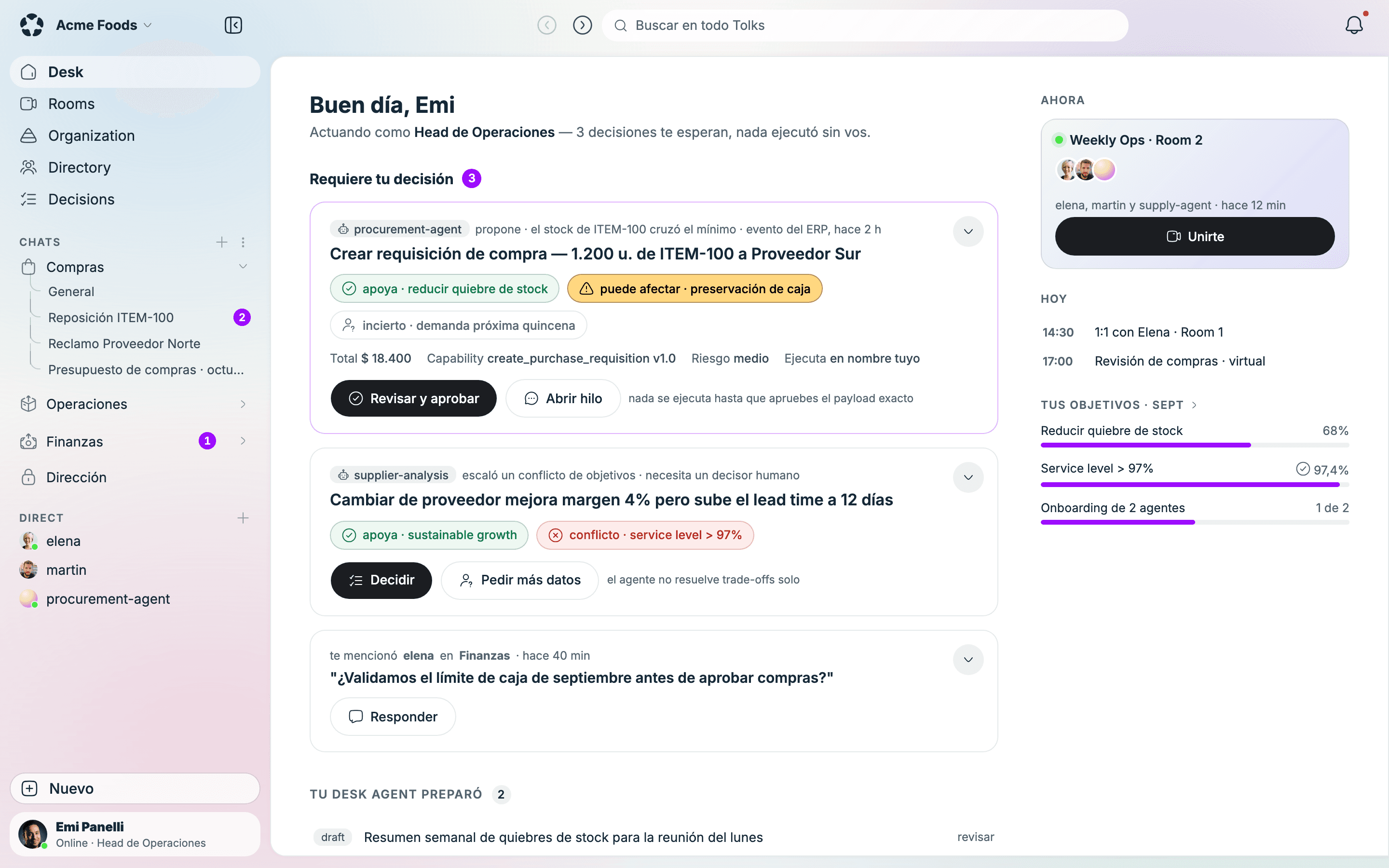
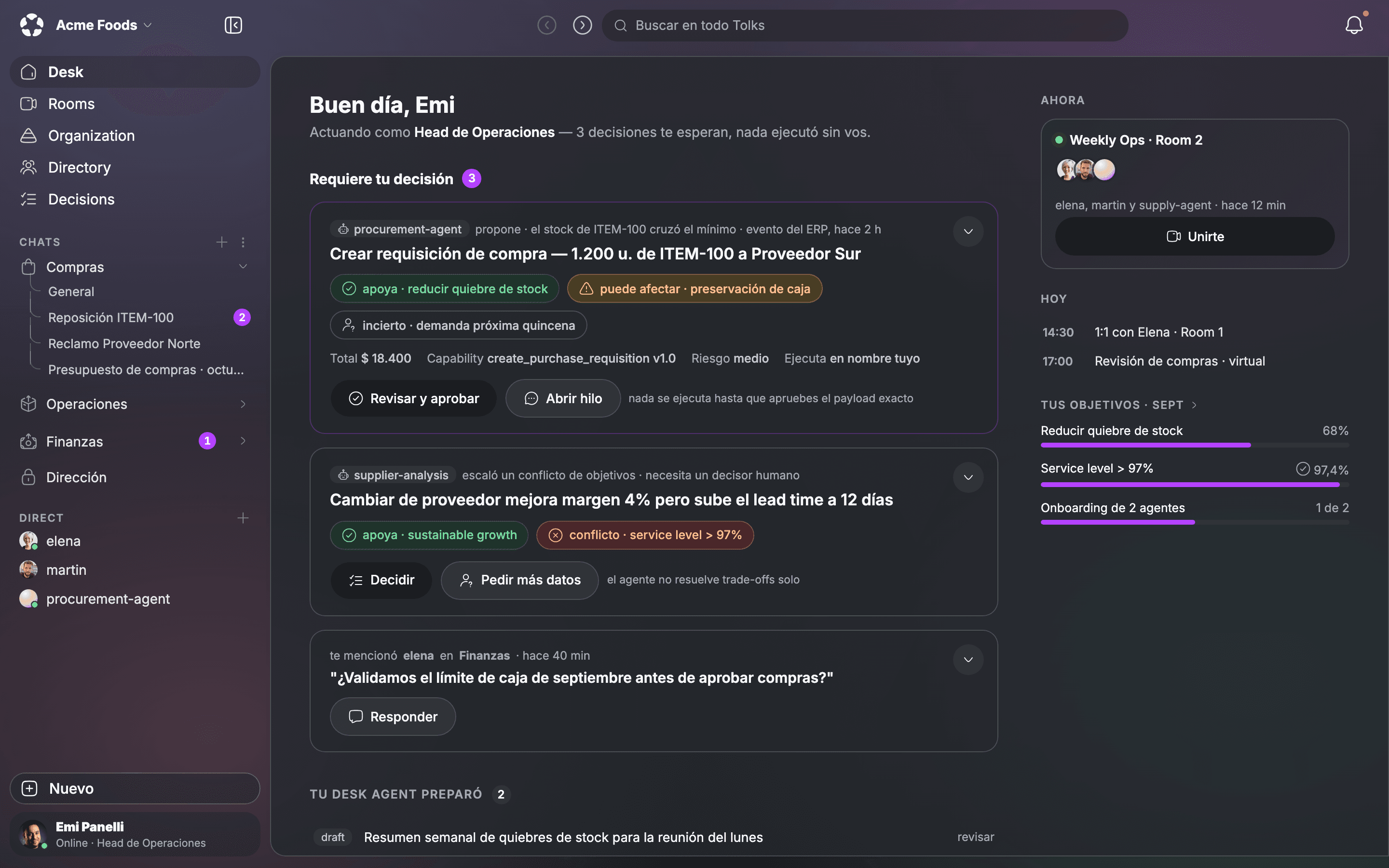
Your company already has people who decide and systems that record. Tolks adds agents that propose — in the same place, under the same rules, with every decision written down.
Sources, uncertainty and the impact on your objectives come declared up front. An agent that recommends without showing its work doesn't get to the Desk.
An agent can have the capability to place an order. That is not the same as the authority to do it. Where that line sits — by process, by amount, by risk — is yours to draw.
Your ERP, your CRM and your inbox stay where they are. Agents reach them through governed capabilities, never a raw write, and a receipt comes back with what was verified.
Who asked, who approved, under which authority, who disagreed, what happened after. Reconstructable next quarter, not lost in a thread.
This is what a normal Tuesday looks like inside Tolks. No screenshots — the panel on the right is the app itself, acting it out.
Stock for ITEM-100 drops below minimum. A rule you wrote catches it, and the procurement agent opens a chat in #purchasing with the people who need to be there.
Finance drops in: there's $142k left in this month's budget. No side threads, no forwarded emails. The constraint lives next to the problem, and the product sheet and the policy are admitted into the chat, in plain sight.
Three approved suppliers compared. One recommendation. Sources, uncertainty and the impact on your objectives, declared up front.
It lands on your Desk. You read the evidence and approve, reject or send it back. The agent has the capability to place the order. It doesn't have the authority. You do.
The purchase order is created in your ERP through a governed capability, never a raw write. A receipt comes back with what was verified and when.
The decision goes into the ledger: who decided, under which authority, who disagreed. Objectives update. Next time, everyone knows why.
It works the same on your laptop and on your phone.
What needs your decision today, and nothing else.
Channels and sub-chats where proposals are born, with the context they need admitted next to them.
The living office. Drop in, deliberate, decide. In person, remote or async count the same.
Structure, people and agents, objectives and activity, in one live view.
Humans and agents side by side. Every agent shows who answers for it.
The ledger. What was decided, by whom, with what authority, and what happened after.
Every action an agent takes checks who's asking and what they're allowed to do. A supervisor can resolve a business disagreement and take responsibility for it. No one — supervisor included — can tell the system to break the law, ignore security or violate privacy.
The next leap in enterprise software isn't adding AI to existing apps. It's turning the organization itself into a system people and agents run together.
An agent can have the technical capability to place an order. That isn't the same as having the organizational authority to do it.
We're not building software that has agents in it. We're building a company where people and agents work inside the same operating system.
No spam, no demos you didn't ask for — just an email when it's your turn.